
Waco City Directory Shelves
Waco's surviving city directories are spread across several shelves and digital collections, rather than one complete annual run. The earliest cataloged volume is an 1876 directory credited to John Sleeper and J.C. Hutchins. An 1882-era Waldo volume also appears in catalog sources. Morrison & Fourmy supplies the broadest early-to-mid-century trail, while R.L. Polk and telephone books extend selected later periods. Start by selecting an actual available volume, not a broad catalog span. The Waco-McLennan County Library, Baylor, UT Austin, FamilySearch, and licensed library databases each cover a different part of the record trail.
| Collection | Years | Where Held | Access |
|---|---|---|---|
| John Sleeper and J.C. Hutchins directory | 1876 | Baylor, FamilySearch, and library catalogs | Confirm the physical call number |
| Waldo's Directory of the City of Waco | 1882-era volume located | Baylor, UT, and FamilySearch catalogs | Verify the copy and access route |
| Morrison & Fourmy Waco directories | 1878-1923 represented; selected UT years through 1953 | Baylor, UT catalog, FamilySearch, and library databases | Baylor digitized run and catalog access |
| R.L. Polk & Co. Waco directories | 1916-1926; later UT run 1959-1997 | UT catalog, library, FamilySearch, and Ancestry | Catalog or licensed in-library access |
| Telephone directories | Older volumes and Waco 2006-present listed | UT catalog and local library holdings | Confirm shelf or microfilm availability |
Catalog range labels are useful starting points, not a promise that every issue survives. Baylor describes its digitized group as 1876-1923. UT lists selected dates within broader Morrison & Fourmy and Polk runs, and the local library does not publish a complete Polk shelf inventory. Record the specific publication year before treating a gap as meaningful.
Baylor's Waco Directory Run
Baylor's Texas Collection makes its Waco directory collection available as a starting point for the 1876-1923 period. Its description says the books commonly list a head of household, occupation, and address. They can also preserve relationships, older children, boarders, and sometimes ethnicity, along with advertisements that place a family within the city economy of the time.
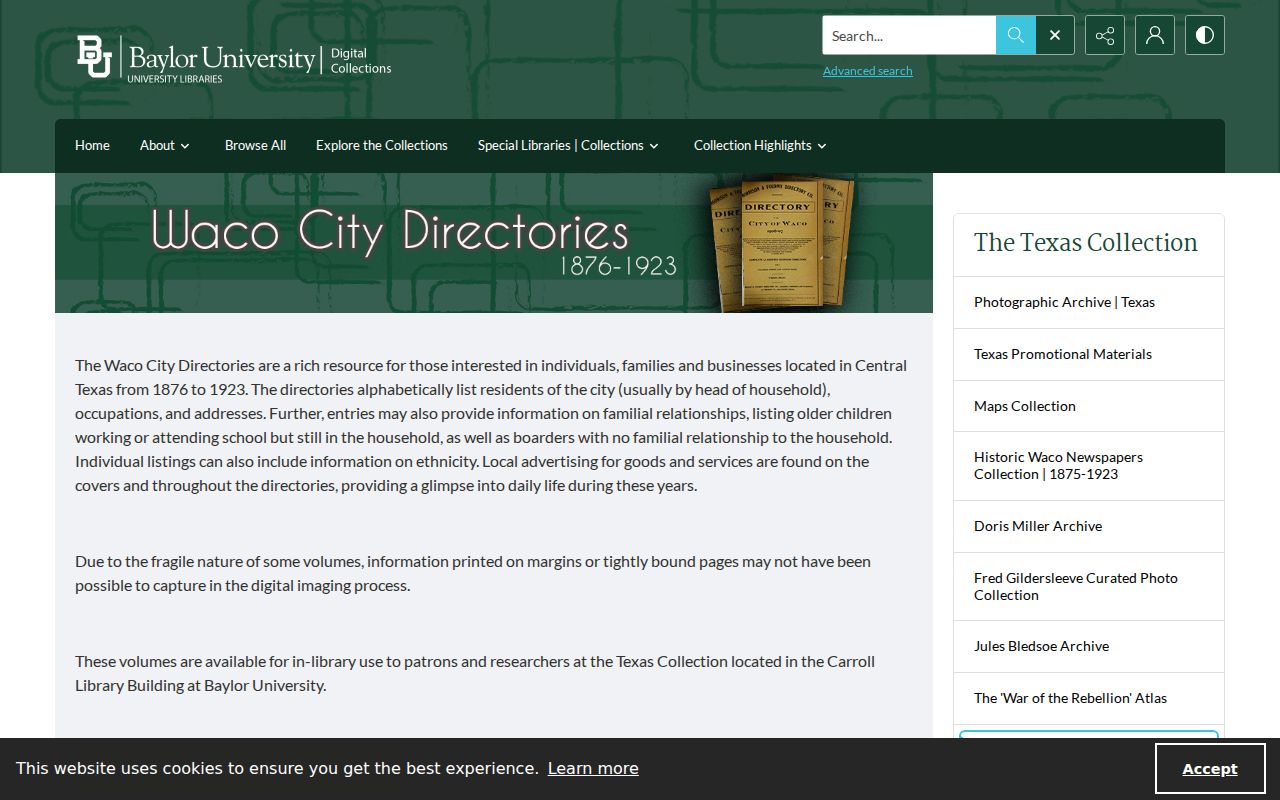
The digitized collection is valuable for quick name checks, but inspect the page image rather than relying only on text recognition. Baylor notes that fragile margins and tight binding may not have been captured. Volumes are also available for in-library use at the Texas Collection in the Carroll Library Building, which is the fallback when an online scan is incomplete.
The digitized 1902-1903 Morrison & Fourmy volume at the Portal to Texas History is a 277-page example of how much more than a name list can survive. It includes alphabetical private and business listings plus officials, churches, schools, banks, hospitals, commercial bodies, secret societies, and a street-and-avenue guide. Its page-level images make it practical to check a spelling or address in context.
Waco City Directory Years
UT Austin's Waco directory catalog widens the search beyond the Baylor scans. It identifies Morrison & Fourmy, Polk, Waldo, telephone, and business directories. The catalog records individual Morrison & Fourmy years including 1886, 1888, 1890, 1898, 1900, 1904, 1907, 1910, 1911, 1913, 1932, 1941, 1943, 1945, 1948, and 1953. It also identifies Polk volumes from 1916, 1919, 1921, and 1923 among the 1916-1926 run.
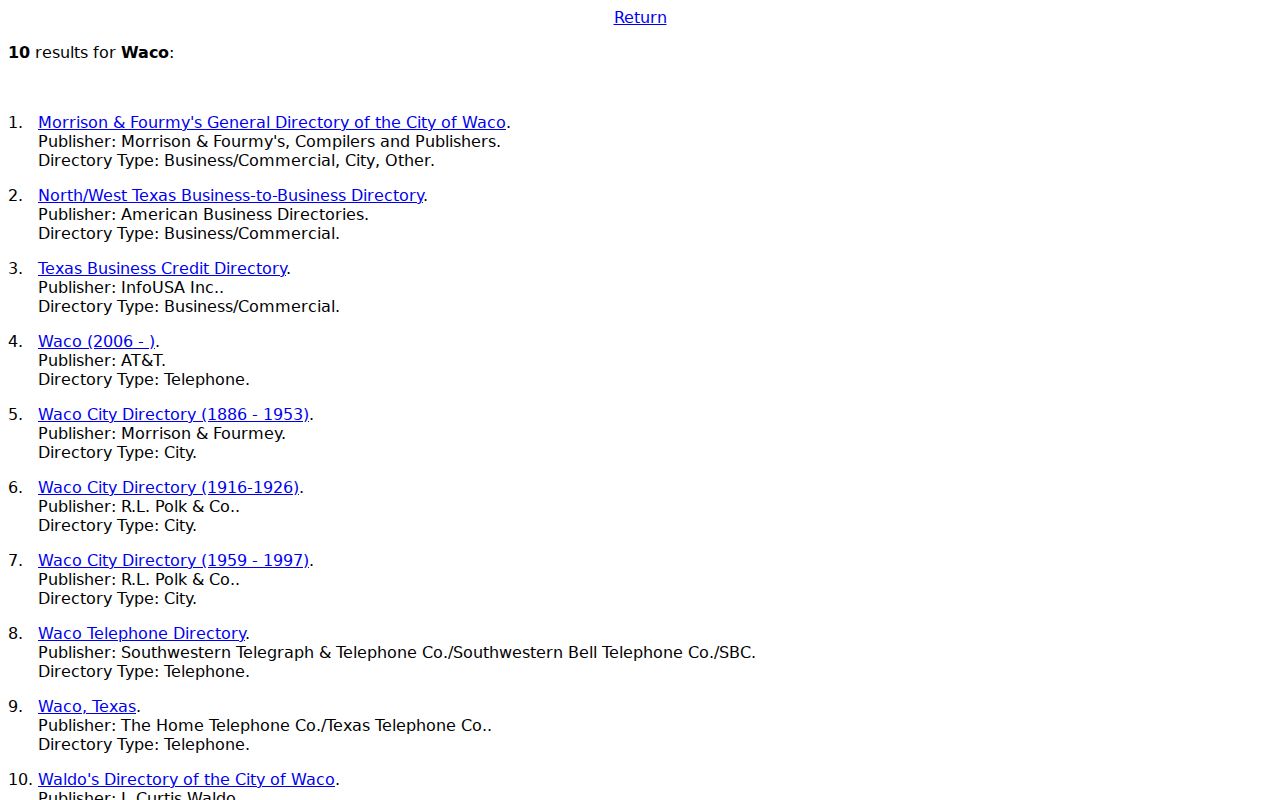
The UT catalog screenshot is a reminder to distinguish a listed title range from a confirmed issue. Check UT's physical-location and loan rules before planning a visit. For a wider explanation of what city books can contain and routes to the Portal to Texas History, use the Texas State Library and Archives city-directory research page.
The surviving chronology gives a sensible first pass:
- 1876: the early Sleeper and Hutchins Waco volume is cataloged.
- 1882-era: a Waldo directory appears in catalog sources.
- 1878-1923: Morrison & Fourmy is represented in the Baylor digital collection.
- 1916-1926: Polk years are listed by UT, followed by a later 1959-1997 Polk run.
That sequence does not show a complete year-by-year publication history. It does provide grounded checkpoints for a household that appears before the First World War, moves during the Polk era, or turns up later in telephone and business listings.
Reading Waco Directory Entries
A historical listing is a compact record, not a full biography. In the inspected Morrison & Fourmy material, the useful pieces to capture are the surname and given name, initials, occupation or business, street address, household relationship where printed, and a separate office or business address. The entry image matters because older books can compress several facts into abbreviations. The state library notes that directory conventions vary by volume, so a mark that looks familiar should never be expanded without checking that volume's own key.
| Name form | Keep the surname, given name, initials, and the exact spelling used by the volume. |
|---|---|
| Work or business | Record the occupation, business, or separate office address when printed. |
| Street address | Capture the house number and street exactly, including directional wording or an older street form. |
| Household clue | Note a spouse, relationship, older child, widow or widower form, or boarder notation if it appears. |
| Marks and initials | Some runs may use home or ownership-status notation. Read the book's own abbreviation key first. |
- Criss-cross directory
- An address-first arrangement, usually ordered by street and number. A separate Waco criss-cross title was not confirmed, so test the street pages or guide within each volume.
- Householder index
- An alphabetical route to the named household, often the first place to locate a surname before checking a street section.
- Abbreviation key
- The printer's explanation of the shortened words and marks used in that issue. Photograph or transcribe it before interpreting a listing.
Do not make an ownership claim from a listing alone. A directory can place a person or business at an address during its publication period, but its entry does not establish citizenship, a precise move date, or title to the parcel.
Waco Directory Access at West Waco
The Waco-McLennan County Library Genealogy Center at West Waco Library is the local fallback when an issue is not digitized or a page image is hard to read. It has a Genealogy Center, Local History Room, public computers, local-newspaper microfilm, Central Texas county-record microfilm, census material, readers that can save or print, and more than 32,000 print items. Staff, volunteers, and free classes add help that a catalog search cannot provide.
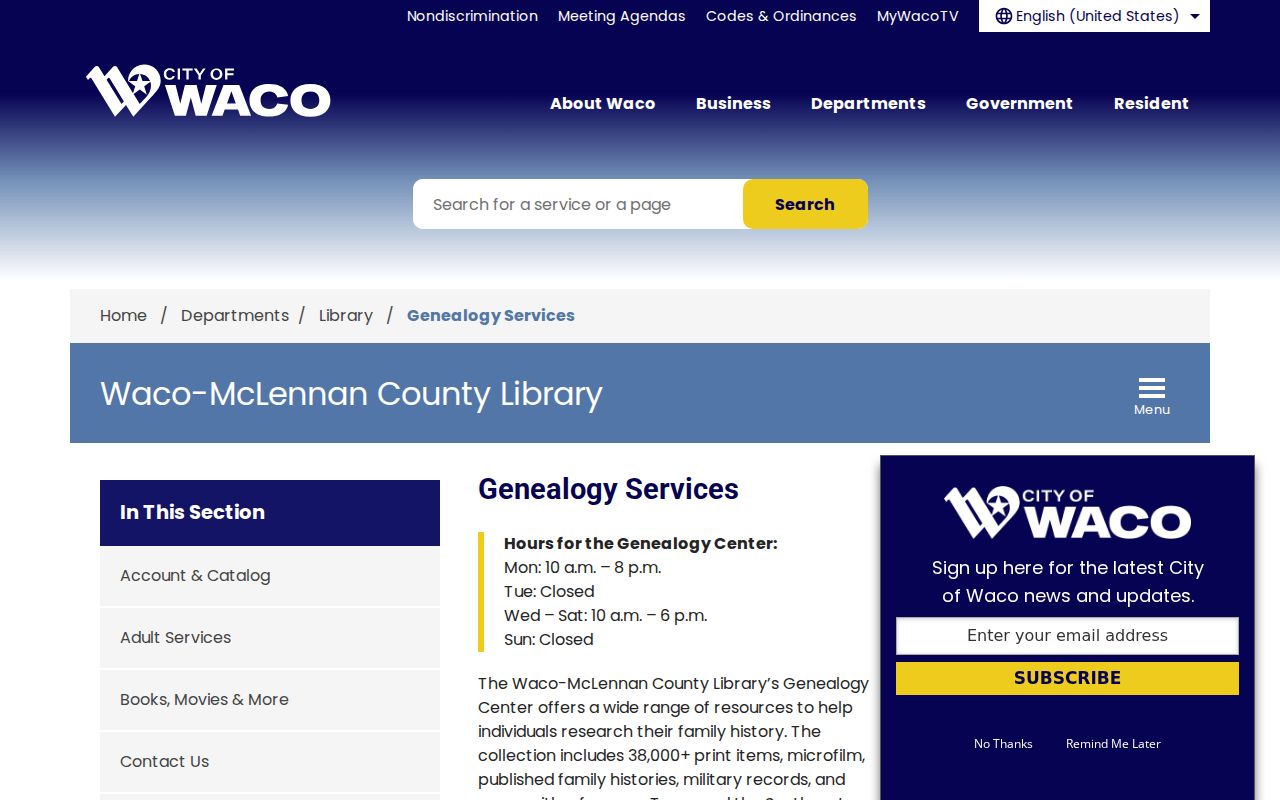
The library picture points to the in-person route for licensed and restricted material. FamilySearch Affiliate access at a library location can open some images unavailable at home with a free FamilySearch account. Ancestry Library Edition and American Ancestors are in-library only, while HeritageQuest, Fold3, HistoryGeo, and Newspapers.com have their own access conditions. Confirm current access before a visit.
At the research date, West Waco announced a flooring closure from August 30 through October 1, 2026. Central, East, and South Waco branches continue services and digital access during that period. The posted Genealogy Center hours were Monday 10 a.m.-8 p.m., Wednesday through Saturday 10 a.m.-6 p.m., with Tuesday and Sunday closed. Call 254-750-5945 before relying on those hours or on a particular machine.
Waco City Directories Across Census Years
Use a directory series to fill the years between federal census releases. The public census runs through 1950 under the 72-year rule as of the 2026 research date, while a directory may record an address and work detail in the years before or after a census date. Pairing them can separate two people with the same name and can reveal a move, a changed trade, or a different household form. A historical entry is evidence to compare, not a final answer.
- Find the first usable volume with the full name and a known Waco address.
- Write down every spelling, initial, spouse or relationship clue, work detail, address, and printed abbreviation.
- Check nearby available years for variant spellings, widow or widower forms, boarders, and a separate business address.
- When a street page is present, search the street and number. If it is absent, use the street guide, a Sanborn map, tax roll, or deed record.
- Compare the dated listing with the closest census, then test the address against probate, cemetery, newspaper, and deed sources.
A disappearance can mean a move, a death, an omitted issue, a spelling change, or a different listing form. The library's newspaper microfilm and research guides help test those possibilities, but the reviewed library pages do not identify a complete online Waco obituary index. A direct directory finding that needs modern confirmation can be checked through the Waco resident lookup route rather than treated as a current result.
Waco Directory Gaps and Scans
Waco's paper trail has enough depth to create false certainty. A directory issue may reflect the prior year's canvass. A tight binding can hide letters at the margin, OCR can misread initials, and a head-of-household convention can leave other household members out. Historical books may list a person under a spouse's name, an employer, a business, or an abbreviated first name. Check the page image and search surname variants before concluding that a person is absent.
For an older address, the April 1885 Waco Sanborn map has nine sheets that can place a street, block, building footprint, use, and construction detail. It normally will not name an ordinary resident. Use it beside a directory entry, not in place of one. County tax rolls, abstract books, and deed books provide additional checks when a street name or number has changed.
Note: no official account of a courthouse fire, flood, or mass record loss was located in the reviewed sources, so a missing entry should not be blamed on a presumed disaster.
Citing a Waco City Directory
A useful citation names the publisher or collection, the directory title, publication year, page or image number, the holding institution, and the URL or physical access route. Preserve the spelling shown in the item, then add a separate note for the normalized name or address used in later searching. This lets another family researcher return to the same image and evaluate the reading.
Advertisements, institutional lists, and street guides deserve citations too. They can date a business, church, school, or neighborhood context even when an individual entry is sparse. Keep the directory publication year distinct from the likely period of residence, and never turn a later catalog range into a claim that every intervening Waco volume exists.