
Waco Previous Residents by Era
They do not appear in one continuous Waco list. Each source has its own date range and its own meaning. A deed establishes a recorded transfer, a directory places a person or household in a published period, a census captures a household at a fixed federal date, and a tax record links an assessed owner to land. Start with the era you need, then carry the same parcel, legal description, street form, and surname variants from source to source. The eras below make clear when an online result should give way to a library, archive, or County Clerk book.
| Source | Years It Covers | Where Held | What It Shows |
|---|---|---|---|
| McLennan OPR electronic index | 1996 to present | County Clerk linked Tyler search | Recorded parties, conveyances, liens, plats, and document dates |
| County deed books | 1849 to 1995 | County Clerk office books | Grantor, grantee, legal description, book, page, and transfer |
| Assessor abstracts and tax rolls | Abstracts 1877-1878 and 1880-1964; tax rolls 1878-1989 | McLennan County Archives | Assessed owner, land, value, and yearly parcel context |
| Old county tax maps | 1990 to present | McLennan County Archives | Parcel and map context when an address changes form |
| Baylor Waco directories | 1876-1923 | Baylor Texas Collection | Address, household, business, boarder, and local context |
| Morrison & Fourmy and Polk runs | Selected Morrison & Fourmy years 1886-1953; Polk 1916-1926 and 1959-1997 | UT Austin directory catalog, library, and licensed databases | Later name and address continuity, subject to gaps |
| Federal census | 1790-1950 public under the 72-year rule | Library databases, FamilySearch, Ancestry, or NARA | Household composition, age, birthplace, and address or geography |
| Waco Sanborn map | 1885 confirmed | Library of Congress | Building footprint, use, stories, street names, and block context |
The electronic record is best for a recent transfer. The County Clerk's books and Archives take over as the trail moves backward. Use Baylor or the library when the question is who lived at a Waco address during a particular period, then use census and obituary evidence to test the household. Catalog ranges identify located volumes, not a promise that every annual issue survives.
Waco Previous Residents and Parcels
Before chasing names, establish the property key. McLennan CAD eSearch accepts owner, address, property, geographic, or CAD ID searches and provides advanced fields for street number, street name, subdivision, neighborhood, tax year, and related property details. The result can identify the current owner, situs address, mailing address, parcel identifiers, legal description, subdivision, lot and block or abstract, values, tax year, physical characteristics, deed references, and a map link.
The situs is the land's physical location. The mailing address is where tax correspondence goes. They can be different, and neither one alone proves who occupied the property. The legal description is the durable link when a Waco street has a directional prefix, an avenue spelling, a changed segment, or an old block number. For current street-by-street searching rather than a backward trail, use the Waco street directory after preserving that parcel identifier.
The McLennan County Tax Office search offers an additional address route. It accepts an owner name, property address beginning with the supplied text, account number, CAD reference, or fiduciary number, with an optional second criterion. It can help cross-check the CAD reference, but a tax-account name is not title proof and it is not a record of every person who lived at the address.
Trace Waco Previous Residents Through Deeds
The McLennan County deed chain begins with the present parcel and moves from buyer to seller. County Clerk records include deeds, deeds of trust, liens, releases, plats, assignments, powers of attorney, assumed names, and other recorded instruments. Read the document rather than only the index row. A deed chain proves an interest transfer, not a complete occupancy history, and abbreviated names or misspellings need a legal-description check.
- Open the current CAD card and copy the situs address, property or geographic ID, full legal description, subdivision, lot or block, and any sale or deed reference.
- In the linked Tyler official-records search, find the current owner as grantee. Record the purchase deed's grantor, execution and recording dates, document number, book or page where shown, and legal description.
- Search that seller as a grantee to locate the seller's earlier acquisition. Check that the legal description, lot, block, subdivision, or abstract matches the same parcel.
- Repeat the buyer-to-seller sequence until the chain reaches a developer, acreage tract, or a book-era record. Keep a dated row for every instrument instead of merging people with the same surname.
- For links before 1996, move to the County Clerk's public workstations and book volumes. Ask the County Archives or clerk staff about indexes for the older series, then cite the precise volume and page.
- Grantor and grantee
- The grantor transfers an interest in a document. The grantee receives that interest. In a backward search, a seller found as grantor is often searched next as a prior grantee.
- Chain of title
- A dated sequence of recorded transfers and related instruments for the same parcel. It is a property history, not a guaranteed list of every household member.
- Legal description
- The recorded land description, such as a lot and block in a subdivision or an abstract and survey reference. It is usually steadier than an old street label.
Waco's access split is important. The County Clerk says all recorded documents from 1849 through 1995 remain in office books, while electronic OPR begins January 1, 1996. Deed and deed-of-trust books from December 1968 through December 1995 are specifically identified, as are mechanics-lien books from April 1969 through December 1995. A blank online search before that cutoff is a signal to use the office route, not evidence that the property lacked a prior transfer.
Waco Directories for Previous Residents
Directories add the household layer that deeds leave out. Baylor's digitized Waco collection covers 1876 through 1923 and describes entries that commonly list a head of household, occupation, address, family relationships, older children, boarders, and sometimes ethnicity. The 1902-1903 Morrison & Fourmy volume also includes a street and avenue guide. Read the page image when possible because tight binding and optical character recognition can lose initials, abbreviations, or part of an address.
The Waco Library building and family-history research guides connect address work with vital, cemetery, newspaper, census, and print or digital collections. The Genealogy Center at West Waco Library has print holdings, Central Texas county-record microfilm, local newspapers, public computers, staff or volunteer help, and FamilySearch Affiliate access. Current access should be checked during the announced August 30 to October 1, 2026 flooring closure, when other library branches remain relevant.
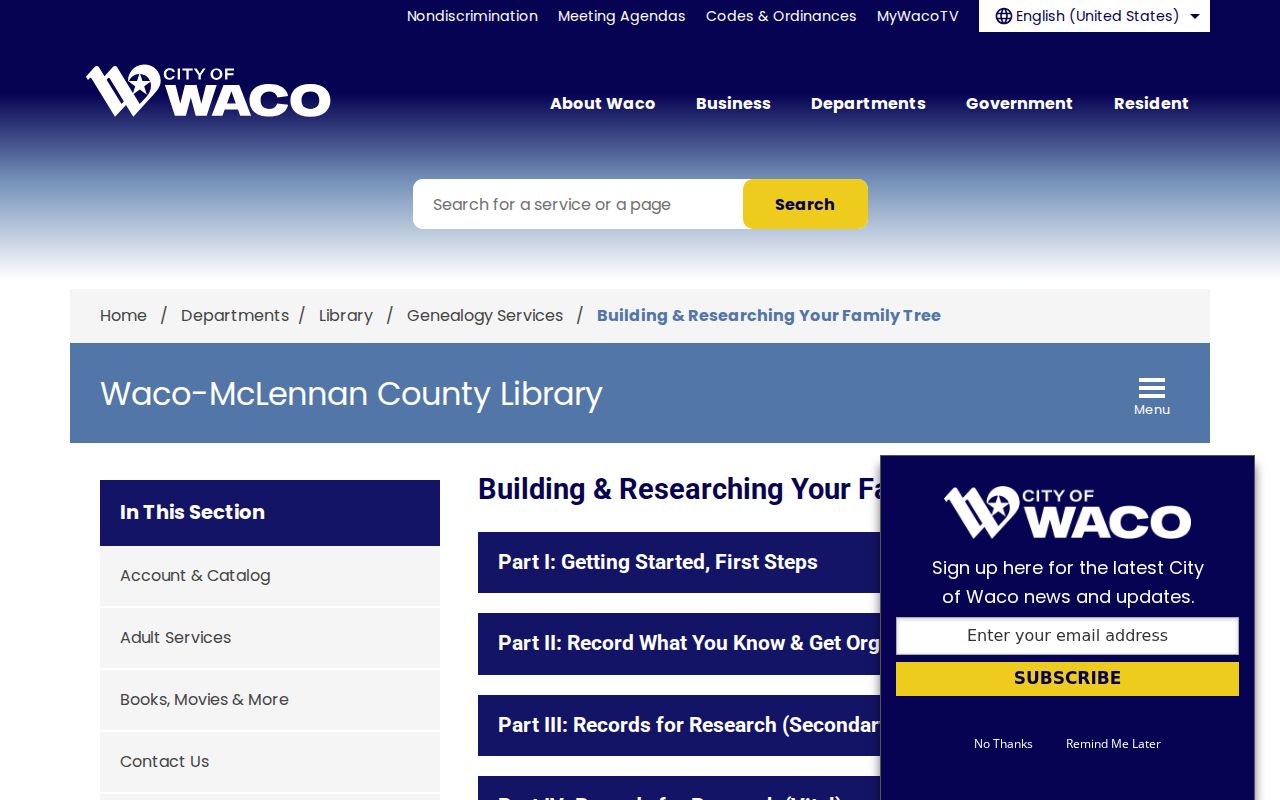
The research-guide hub is a useful starting point for selecting a source by period instead of treating a directory as a complete roster. In-library access matters: Ancestry Library Edition and American Ancestors are listed as in-library resources, while FamilySearch Affiliate access can open some images unavailable from home. The library's directory and newspaper resources are the practical fallback when an online catalog has no matching volume.
Waco's prior-residents trail benefits from a cautious reading of directory terms. An entry can identify a person at an address for a publication period, but it does not establish ownership, citizenship, or the exact moving date. The separate Waco city directories resource focuses on the collections and how to read their entries; use the exact volume year before making a historical claim.
Pair Waco Directories With Census
Use directories and census schedules as two dated views of a household. Federal census records through 1950 are public under the 72-year rule as of the research date. Census pages can add household composition, age, birthplace, and geography. Directories fill the years between census dates and can show an address, an occupation or business, spouse notation, a boarder entry, or a separate business address. Neither source should be treated as a current-residence claim.
- Choose the directory volume nearest the address period and transcribe the name exactly, including initials, spouse notation, address, business name, and abbreviations.
- Check adjacent available volumes for variant spellings, widow or boarder terms, and a changed business address. Note that a directory's publication year can reflect an earlier canvass period.
- Pair the result with the nearest public census. Search Waco, McLennan County, township, precinct, and nearby-place geography because city and county boundaries can differ across time.
- Test the household with the deed chain, tax roll, newspaper notice, cemetery record, or probate file. Preserve the date and source for each person rather than forcing every name into a single timeline.
When a person disappears from a directory, the Waco-McLennan County Library's newspaper microfilm and cemetery or vital-record guides are the verified next sources. Its historic newspaper runs include the Waco Weekly Telegraph, Waco Daily Examiner, Waco Daily News, Waco Times Herald, Waco News Tribune, Waco Citizen, and Waco Tribune-Herald, with stated gaps possible. No complete standalone Waco obituary index title or date range was verified, so ask the Genealogy Center rather than promising one.
Waco Previous Residents in Maps
Maps and assessments test whether an old address describes the same place. The Library of Congress Waco Sanborn map is an April 1885 set of nine sheets. It can show a building footprint, construction material, stories, use, street names, and fire-risk features. It normally does not name ordinary residents. Use it to place an address or structure in time before connecting it to a directory or deed.
The County Archives adds assessor abstract books for 1877-1878 and 1880-1964, tax rolls for 1878-1989, and old tax maps from 1990 forward. These sources may put an owner on land for a particular year when a deed is hard to read or an address string has changed. Waco's street grid includes numbered streets, directional prefixes, and named avenues; a street segment may later be renamed or abandoned. Recent planning consideration of renaming part of N. 42nd Street to Lions Way is a reason to verify any apparent match with plats, maps, and legal description.
For a later change to the structure, Waco EnerGov/Citizen Self Service records project or property address, application or permit type, applicant or contractor, plan uploads, payments, inspections, and checklist views after the appropriate account steps. Development Services and a written city request are alternatives for existing non-exempt material. A permit can date work on a structure; it does not identify every person who lived there.
Waco Address Changes and Gaps
The most useful Waco comparison is between online coverage and physical coverage. The electronic OPR index starts in 1996, but the County Clerk's recorded books reach back to 1849. County Archives tax records have still different date ranges. Baylor digitizes a rich directory period, while UT catalog listings identify selected later runs. The answer to a missing name is often a different access channel, not a conclusion that no one was associated with the address.
Build a four-part timeline: date or year, source and custodian, normalized address or legal description, and the person's documented role. Treat a 1902 directory entry, a 1998 deed, and a current CAD card as three observations. They should not become one unbroken narrative without supporting records. Search variant surname spellings, initials, married or widow forms, business names, and old street formats, then confirm uncertain joins against the original image or book.
Note: A Waco address may be a postal, map, tax, or recorded-land description at different times, so record the source's exact wording before standardizing it.
Waco Previous Residents Privacy
House history and family research have limits. A deed can show a recorded party, and a directory can show a period address, but neither opens protected vital records, private utility accounts, or a private household roster. Texas protects certain voter addresses and confidential identifiers, and the Attorney General's Address Confidentiality Program provides substitute-address procedures for eligible participants. Do not attempt to reverse a withheld address or infer a physical location from a substitute one.
For an estate or family question, probate can connect a decedent, fiduciary, heirs, notices, and a later transfer, subject to the court's access rules. An obituary or cemetery entry is a lead to corroborate with a vital record or deed. Waco's Greenwood Cemetery has complex ownership and incomplete historical records, and burial-location questions are routed through the Library Genealogy Center. Those limits are part of an honest address history.
Lawful use. Research on Waco previous residents is suited to house history, genealogy, estate questions, and personal curiosity. Do not use a historic address trail to track, harass, intimidate, or harm a living person.